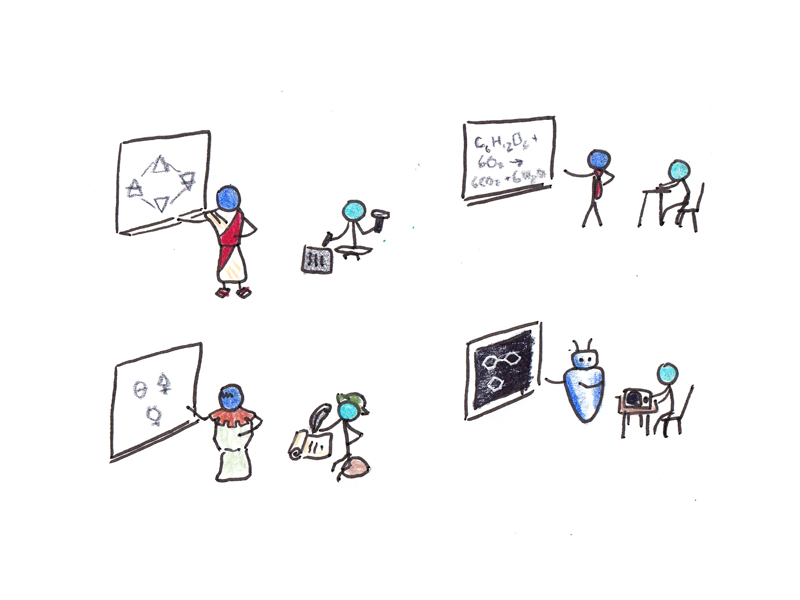
From the floor of HumanX, Ryan welcomes Songyee Yoon, managing partner at Principal Venture Partners (PVP), to chat about AI development outside the US, from the need to adapt models to local languages and culture to the challenges of the global supply-chain for things like semiconductors to how venture capital is looking at international AI companies. �...
arXiv:2606.05176v1 Announce Type: new
Abstract: While large language models (LLMs) show strong performance in natural language understanding and generation, their evaluation and adaptation to domain-specific constraints in telecommunications customer support remain limited. In addition, data sovereignty, regulatory constraints, and the handling of sensitive customer and network information complicate the use of externally hosted foundation models in this domain.
We present a systematic stu...
arXiv:2606.05175v1 Announce Type: new
Abstract: We study generic triple-latent sequence models that maintain a running token state and compressed pair-memory pathway to capture higher-order token interactions without benchmark-specific parsing. The triple-latent family improves a small Transformer baseline on byte-level WikiText-2 and on a tokenizer-based MiniMind language-model benchmark, while a recall-focused gated key-value retrieval extension improves associative recall but remains seed...
arXiv:2606.05174v1 Announce Type: new
Abstract: Large Language Models (LLMs) have shown strong promise in healthcare applications. Yet deploying general-purpose models in real-world settings remains difficult due to data privacy constraints, inference costs, and limited suitability for edge or on-device use. These challenges motivate the development of smaller, more efficient models that require robust post-training strategies to ensure reliable medical reasoning. In this work, we investigat...
arXiv:2606.05173v1 Announce Type: new
Abstract: Masked language modelling (MLM) has been the dominant pre-training objective for text encoders since BERT, yet it encourages representations that are strongly anchored to surface-form token identity rather than deeper semantic structure. Inspired by the success of Joint Embedding Predictive Architectures (JEPA) (LeCun, 2022) in vision and audio, we propose a hybrid pre-training objective that combines a JEPA-style latent-space prediction loss w...
arXiv:2606.05172v1 Announce Type: new
Abstract: Diffusion-based image editing has achieved strong visual fidelity under natural language instructions, yet most existing systems still operate at the level of surface instruction following, without reasoning about the implicit contextual constraints embedded in real user requests. This often leads to visually plausible but logically inconsistent edits. In this work, we introduce RE-Edit, a benchmark for REasoning-aware image Editing that evalua...
arXiv:2606.05171v1 Announce Type: new
Abstract: The OpenClaw platform provides a practical foundation for automation through its skill-oriented architecture, organizing external capabilities into lightweight, reusable components that can be invoked efficiently through a command-line interface (CLI). However, a significant bottleneck remains: many real-world tasks are confined to graphical user interfaces (GUIs) with no stable API available. While LLM-based GUI agents offer generality, their ...
arXiv:2606.05170v1 Announce Type: new
Abstract: At matched accuracy, open-weight LLMs differ substantially in the shape of their error severity distribution -- a difference invisible to the scalar error rate. Hallucination benchmarks report a single error count and treat all errors as equivalent, yet a wrong date and a fabricated court ruling differ by orders of magnitude. We introduce Errorquake-10k, a 10,000-query benchmark scoring each response on a continuous 0-4 severity scale across 8 ...
arXiv:2606.05169v1 Announce Type: new
Abstract: We give a stereological theory of LLM benchmark coverage. For any suite with effective dimensionality d_eff, the visible Hausdorff distance between two convex capability profiles consistent with the same scores is bounded by epsilon + C R m^(-1/(d_eff-1)), with matching Lipschitz lower bound. Empirically, three independent leaderboards (Open LLM v2, an extended 12-benchmark suite, LiveBench) all have d_eff in [2.86, 4.80] on their competitive f...
arXiv:2606.05168v1 Announce Type: new
Abstract: Training on synthetic data causes model collapse, but existing analyses treat this as single-chain degradation. In reality, the AI ecosystem involves cross-contamination: models ingest synthetic data from other models, produce new synthetic text, and contaminate shared corpora. We propose a bilayer coupled SIR/SIRS framework -- a phenomenological mean-field model treating data corpora and AI models as two interacting populations, each with susc...
arXiv:2606.05167v1 Announce Type: new
Abstract: Realism is a central yet seemingly under-theorized concept in Agent-Based Modelling. This paper presents a Systematic Literature Review, aiming to identify how realism is currently operationalized and demonstrated. The results show that realism is often poorly defined and lacks a consistent conceptual framework. A wide variety of methods are used to achieve and demonstrate realism, but explanations of whether and why these methods are appropria...
A read-only preset, like block_size — SHOW data_checksums tells you whether the cluster has page checksums, and that’s the only interaction the GUC offers. But unlike block_size, this one has a thirteen-year history that’s still being written, and the history is the post.
When checksums are on, e…
How Airbnb built a Kubernetes sidecar to deliver dynamic configuration reliably at scale.By: Bo Teng, Cosmo Qiu, Siyuan Zhou, Ankur Soni, Xin Huang, Willis HarveyIntroductionIn our previous post, we explored Airbnb’s dynamic configuration system, Sitar, with a focus on service architecture and configuration change safety. Now for the harder question: once a config change is committed, which happens several times each minute, how does it actually reach the thousands of Airbnb’s service i...
 xAI
xAI