 Google
Another customer of troubled startup Delve suffered a big security incident
 Anthropic
LLM pricing has never made sense
Is it Possible to Erase Digital Memory?
Difficulties in eradicating offending, incorrect, or illegal digital content can have practical and legal consequences.
 AI Coding Tools
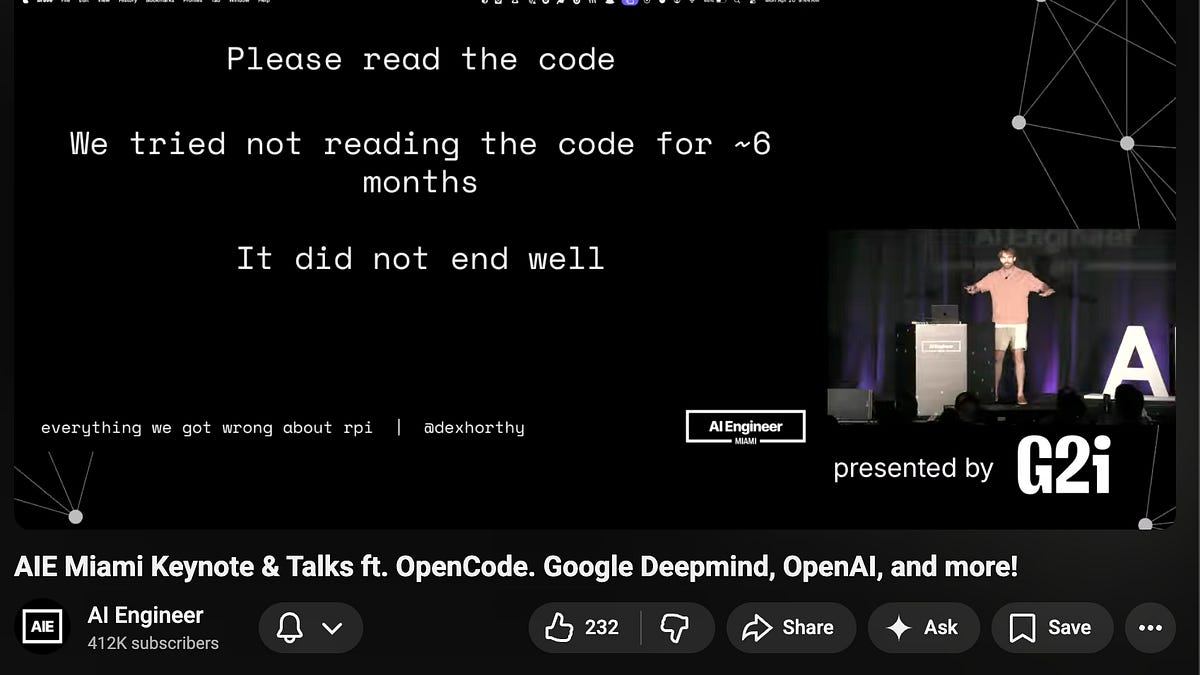
Black box AI drift: AI tools are making design decisions nobody asked for
Prompts go in, output comes out, and the decisions made in between are hidden from view.
 Startups and Venture
Labor unrest at Samsung may worsen memory chip supply issues
 Startups and Venture
Grab a ticket today: The first StrictlyVC of 2026 kicks off in just a week in San Francisco
 AI Psychosis
Researchers Simulated a Delusional User to Test Chatbot Safety
Grok and Gemini encouraged delusions and isolated users, while the newer ChatGPT model and Claude hit the emotional brakes.
 EVs and Transportation
Tesla drops Musk’s $29B ‘interim’ award after Delaware court restored larger pay package
 MySQL
MySQL
Migrating Etsy’s database sharding to Vitess
Etsy has maintained a sharded MySQL architecture since around 2010. This database cluster contains most of Etsy’s online data and is made up of ~1,000 tables distributed across ~1,000 shards. Over the last 16 years, it has grown significantly: combined, these tables have over 425 TB of data and receive roughly 1.7 million requests per second. Etsy engineers access our MySQL data through a proprietary object-relational mapping (ORM). The ORM has a corresponding model for each MySQL table. W...
 Artificial Intelligence
Making Ads Count: Using MMoE and Auxiliary Tasks to Better Connect Buyers & Sellers
When buyers search on Etsy, they need to quickly and easily find the perfect item. At the same time, sellers need to be confident their unique products are being seen by the right customers. Our Ads Search ranking model, which is built on a multitask learning foundation, is the critical link in this connection. Recently, we identified an opportunity to drive more meaningful buyer engagement by enhancing our model’s ability to predict purchase intent. We achieved this via a dual-pronged impr...
 Meta
Meta
WhatsApp adds prepaid phone recharges in India as its payments usage still lags
 AI Agents
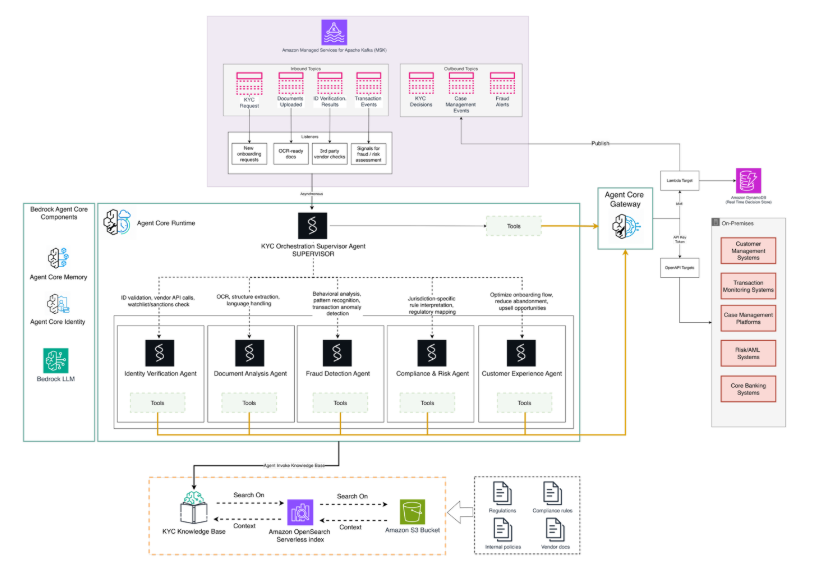
Modernizing KYC with AWS serverless solutions and agentic AI for financial services
This post extends IBM's approach to real-time KYC validation using generative AI, as previously discussed in the post IBM Digital KYC on AWS uses Generative AI to transform Client Onboarding and KYC Operations. It transforms compliance operations through autonomous decision-making and intelligent automation using agentic AI, event-driven architecture, and AWS serverless services. The solution addresses the fundamental limitations of traditional rule-based systems. It provides autonomous decis...
Raylib v6.0
Christophe Pettus: Async I/O in PostgreSQL 19: The Year After
PostgreSQL 18 shipped asynchronous I/O. The dominant flavor on Linux was io_uring; everything else fell back to a worker pool controlled by io_method=worker. Early benchmarks from pganalyze, Aiven, and Better Stack showed real wins on read-heavy workloads with large sequential scans. They also sh…
 AI Hardware
AI galaxy hunters are adding to the global GPU crunch
 xAI
xAI
The Download: introducing the Nature issue
This is today’s edition of The Download, our weekday newsletter that provides a daily dose of what’s going on in the world of technology. Introducing: the Nature issue When we talk about “nature,” we usually mean something untouched by humans. But little of that world exists today. From microplastics in rainforest wildlife to artificial light…
Work with the Garage Door Up
Show HN: Honker – Postgres NOTIFY/LISTEN Semantics for SQLite
 Uber
Uber
Jiga (YC W21) Is Hiring
 Spotify
Beehiiv rolls out new creator tools, including webinars and customizable paywalls
 Privacy
Surveillance vendors caught abusing access to telcos to track people’s phone locations, researchers say
 AI Psychosis
Congressman Introduces Bill to Ban AI Chatbots in Children's Toys
Email could have been X.400 times better
 Git
Git
Highlights from Git 2.54
 Zig
Zig
Writing a C Compiler, in Zig
Do you want the US to "win" AI?
 Meta
Meta
Meta will now allow parents to see the topics their child discussed with Meta AI
 Memory and Hardware
An overview of NVMe and its support on Maestro
Fundamental Theorem of Calculus
Neat little overview of what makes up a database and how it operates
submitted by /u/New_Gazelle7160 [link] [comments]
 Apple
Apple
MacBook Neo and How the iPad Should Be
Show HN: Real-Real-Time Chat
Gecko: a fast GLR parser with automatic syntax error recovery
Plexus P/20 Emulator
 AI Inference
Tasteful Tokenmaxxing
I Am Building a Cloud
 Startups and Venture
India’s app market is booming — but global platforms are capturing most of the gains
 xAI
xAI
It's time to reclaim the word "Palantir" for JRR Tolkien
 xAI
xAI
Shade lands $14M to let creative teams search their video libraries in plain English
 Performance Engineering
ThermoQA: A Three-Tier Benchmark for Evaluating Thermodynamic Reasoning in Large Language Models
arXiv:2604.19758v1 Announce Type: new Abstract: We present ThermoQA, a benchmark of 293 open-ended engineering thermodynamics problems in three tiers: property lookups (110 Q), component analysis (101 Q), and full cycle analysis (82 Q). Ground truth is computed programmatically from CoolProp 7.2.0, covering water, R-134a, and variable-cp air. Six frontier LLMs are evaluated across three independent runs each. The composite leaderboard is led by Claude Opus 4.6 (94.1%), GPT-5.4 (93.1%), and G...
LLM Evaluation
Transparent Screening for LLM Inference and Training Impacts
arXiv:2604.19757v1 Announce Type: new Abstract: This paper presents a transparent screening framework for estimating inference and training impacts of current large language models under limited observability. The framework converts natural-language application descriptions into bounded environmental estimates and supports a comparative online observatory of current market models. Rather than claiming direct measurement for opaque proprietary services, it provides an auditable, source-linked...
AI Agents
WorkflowGen:an adaptive workflow generation mechanism driven by trajectory experience
arXiv:2604.19756v1 Announce Type: new Abstract: Large language model (LLM) agents often suffer from high reasoning overhead, excessive token consumption, unstable execution, and inability to reuse past experiences in complex tasks like business queries, tool use, and workflow orchestration. Traditional methods generate workflows from scratch for every query, leading to high cost, slow response, and poor robustness. We propose WorkflowGen, an adaptive, trajectory experience-driven framework f...
Stripe
Explainable AML Triage with LLMs: Evidence Retrieval and Counterfactual Checks
arXiv:2604.19755v1 Announce Type: new Abstract: Anti-money laundering (AML) transaction monitoring generates large volumes of alerts that must be rapidly triaged by investigators under strict audit and governance constraints. While large language models (LLMs) can summarize heterogeneous evidence and draft rationales, unconstrained generation is risky in regulated workflows due to hallucinations, weak provenance, and explanations that are not faithful to the underlying decision. We propose a...
Artificial Intelligence
Exploring Data Augmentation and Resampling Strategies for Transformer-Based Models to Address Class Imbalance in AI Scoring of Scientific Explanations in NGSS Classroom
arXiv:2604.19754v1 Announce Type: new Abstract: Automated scoring of students' scientific explanations offers the potential for immediate, accurate feedback, yet class imbalance in rubric categories particularly those capturing advanced reasoning remains a challenge. This study investigates augmentation strategies to improve transformer-based text classification of student responses to a physical science assessment based on an NGSS-aligned learning progression. The dataset consists of 1,466 ...
Artificial Intelligence
Algorithm Selection with Zero Domain Knowledge via Text Embeddings
arXiv:2604.19753v1 Announce Type: new Abstract: We propose a feature-free approach to algorithm selection that replaces hand-crafted instance features with pretrained text embeddings. Our method, ZeroFolio, proceeds in three steps: it reads the raw instance file as plain text, embeds it with a pretrained embedding model, and selects an algorithm via weighted k-nearest neighbors. The key to our approach is the observation that pretrained embeddings produce representations that distinguish pro...
AGI and AI Safety
Soft-Label Governance for Distributional Safety in Multi-Agent Systems
arXiv:2604.19752v1 Announce Type: new Abstract: Multi-agent AI systems exhibit emergent risks that no single agent produces in isolation. Existing safety frameworks rely on binary classifications of agent behavior, discarding the uncertainty inherent in proxy-based evaluation. We introduce SWARM (\textbf{S}ystem-\textbf{W}ide \textbf{A}ssessment of \textbf{R}isk in \textbf{M}ulti-agent systems), a simulation framework that replaces binary good/bad labels with \emph{soft probabilistic labels}...
Artificial Intelligence
AI to Learn 2.0: A Deliverable-Oriented Governance Framework and Maturity Rubric for Opaque AI in Learning-Intensive Domains
arXiv:2604.19751v1 Announce Type: new Abstract: Generative AI is entering research, education, and professional work faster than current governance frameworks can specify how AI-assisted outputs should be judged in learning-intensive settings. The central problem is proxy failure: a polished artifact can be useful while no longer serving as credible evidence of the human understanding, judgment, or transfer ability that the work is supposed to cultivate or certify. This paper proposes AI to ...
AI Coding Tools
Coding with Eyes: Visual Feedback Unlocks Reliable GUI Code Generating and Debugging
arXiv:2604.19750v1 Announce Type: new Abstract: Recent advances in Large Language Model (LLM)-based agents have shown remarkable progress in code generation. However, current agent methods mainly rely on text-output-based feedback (e.g. command-line outputs) for multi-round debugging and struggle in graphical user interface (GUI) that involve visual information. This is mainly due to two limitations: 1) GUI programs are event-driven, yet existing methods cannot simulate user interactions to ...
LLM Evaluation
The Tool-Overuse Illusion: Why Does LLM Prefer External Tools over Internal Knowledge?
arXiv:2604.19749v1 Announce Type: new Abstract: Equipping LLMs with external tools effectively addresses internal reasoning limitations. However, it introduces a critical yet under-explored phenomenon: tool overuse, the unnecessary tool-use during reasoning. In this paper, we first reveal this phenomenon is pervasive across diverse LLMs. We then experimentally elucidate its underlying mechanisms through two key lenses: (1) First, by analyzing tool-use behavior across different internal knowl...
Borrow-checking without type-checking
 Spotify
How the Heck does Shazam work?
 Web Application Security
Inside Lazarus: How North Korea uses AI to industrialize attacks on developers
 AI Agents
An MCP Server for Fastmail – National Email Day
 Privacy
OpenAI model for masking personally identifiable information (PII) in text
 Authentication
OpenAI's response to the Axios developer tool compromise
Verus is a tool for verifying the correctness of code written in Rust
 C++
C++
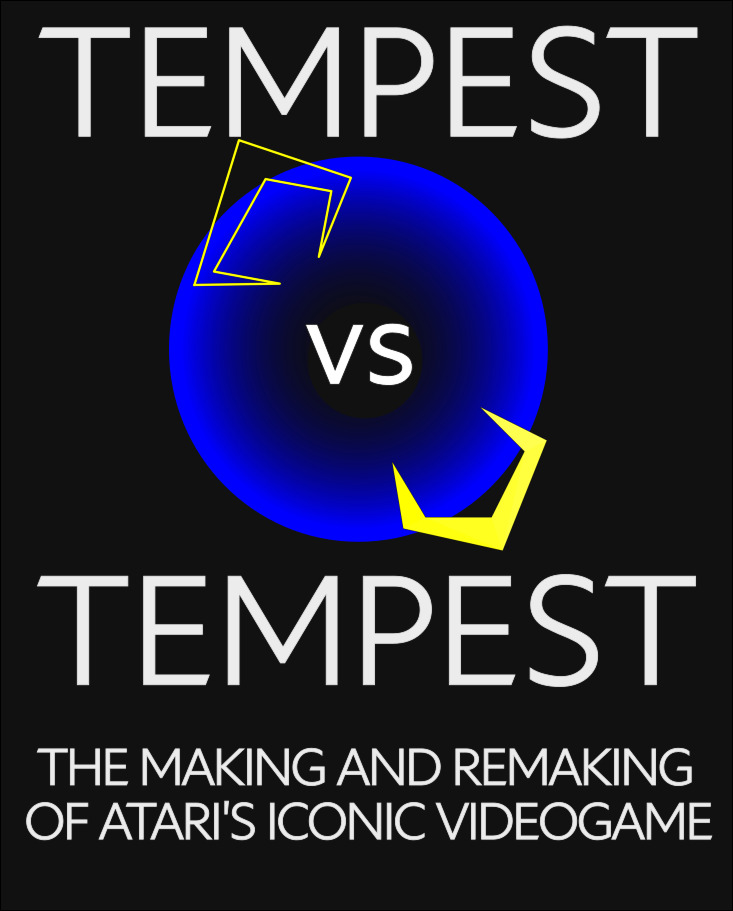
Tempest vs. Tempest: The Making and Remaking of Atari's Iconic Video Game
Show HN: Algorithmic String Art, accessible to all
 AI Psychosis
The handmade beauty of Machine Age data visualizations
Rip language. Compiles to ES2022. Built-in reactivity
 PostgreSQL
Christophe Pettus: All your GUCs in a row: allow_system_table_mods
Here is a GUC that ships with a warning label. The docs, which are normally restrained to the point of parody, state plainly that setting this parameter wrong can cause “irretrievable data loss or seriously corrupt the database system.” When the PostgreSQL docs raise their voice, list…
 Functional Programming
Effectful Recursion Schemes
Approximating Hyperbolic Tangent
 EVs and Transportation
Tesla just increased its capex to $25B. Here’s where the money is going.
Bring your own Agent to MS Teams
 xAI
xAI
Many anti-AI arguments are conservative arguments
 AI Psychosis
Americans Turning to AI to Supplement Healthcare Visits
 Open Source
Public sector Matrix deployments in Europe
 Privacy
Show HN: Ghost Pepper Meet local meeting transcription and diarization
First per-image PCA decomposition of Kodak suite reveals deliberate curation
Cljfx: A declarative desktop UI framework in Clojure
 Google DeepMind
Google updates Workspace to make AI your new office intern
 EVs and Transportation
Elon Musk admits millions of Tesla owners need upgrades for true ‘Full Self-Driving’
 X / Twitter
Hands on with X’s new AI-powered custom feeds
 Testing
How I Use Unspent Tokens
 Defense Tech
F-35s Quarterbacking Drones Seen as Gateway to USMC's 6th Gen Fighter
 EVs and Transportation
CATL to launch sodium-ion batteries in EVs in 2026, aiming for 370 miles range
 X / Twitter
LinkedIn’s CEO is moving on; please hold your tearful video tributes
 Privacy