arXiv:2607.28629v1 Announce Type: new
Abstract: The rapid transition from reactive large language models (LLMs) to persistent, action-capable systems has exposed critical gaps in the architectural understanding of Agentic AI, particularly in separating inference, orchestration, and execution layers for autonomous AI agents. Despite recent advances, unified frameworks for designing and evaluating full-stack agentic systems remain limited. This paper presents a comprehensive, layered architecture
Memory Safety’s Hardest Problem
Jul 20, 2026
Uplifting a
lobsters comment
for easier reference.
The central memory safety counter example, the hardest case to solve, doesn’t have anything to do
with destructors or heap:
const std = @import("std");
const E = union(enum) {
a: u128,
b: []const u8,
};
pub fn main() void {
const bad_addr: u128 = @intFromPtr(&main);
var e: E = .{ .b = "hello" };
const oh_no_pointer: *const []const u8 = switch (e) {
.a => unrea
I needed a function that could tell whether a string was a valid
Common Lisp program. In theory, you could just call read on the
string and see if it throws an error, but I don't want to throw
random text at read. It could contain a reader macro or something
nasty. It also would intern a ton of random symbols into the
current package. I wanted a function that would act mostly like the
reader, but not CONS any data or intern any symbols.
So I vibe coded a function that does just
Are there any rust frameworks to build good android/ ios apps with hardware integration like accessing camera, mic, gyro sensors.. etc.? submitted by /u/SquareShort9309 [link] [comments]
Introduction
The efficacy of semantic search relies on the accuracy of the underlying Knowledge Graph (KG). In high-velocity domains like on-demand food delivery or e-commerce, the catalog of entities like dishes, products, and merchants changes rapidly.
Current methods for KG construction and maintenance face three critical challenges:
Inaccuracy and hallucination from Large Language Models (LLMs): Automated models often infer relationships based on statistical text co-occurrence rat
I’ve been a big fan of Renovate for a couple of years already. Renovate scans your repositories, detects outdated package versions, and opens pull requests to automatically bump them. It’s similar to Dependabot in that it keeps your dependencies up to date. If I had to compare them in one sentence, I’d say Renovate is less integrated in the GitHub ecosystem, but handles more ecosystems and, more importantly, is extensible.
This week is Agents Week.As we started thinking about and planning the week, we wrestled with a broader question of what it means to support this new era of agents and what a purpose-built foundation for agents actually looks like. Which brought us to a simpler framing: what is an Agent Cloud? We quickly realized however, that our framing was wrong. Not because it’s the wrong question to ask, but because of who we were asking — ourselves, instead of our agents. It’s no longer about us a
I've been working on syncular for about a year, after having worked (and failed to ship) on the topic back in the old days (https://github.com/bkniffler/debe). Every client has a proper SQLite database; the Rust client uses rusqlite and is shared by Swift, Kotlin, Flutter, React Native and Tauri. The browser has a separate TypeScript implementation using sqlite-wasm and OPFS. I originally wanted to compile the Rust core to WASM and use it everywhere. I had tried something similar with Crux in a
Sharing a project that's been a fun systems-design exercise: a technical-analysis + backtesting engine with a single Rust core exposed three ways. Rust-interesting bits: - Every indicator implements a Next<T> streaming trait, and the batch path (Polars expressions) is proven bit-identical to the streaming path with proptests. One source of truth, no duplicated math. - Python bindings via PyO3 with abi3 — one cp39-abi3 wheel across CPython 3.9+. - The pure-math core (nalgebra) cross-compiles to
A hands-on tutorial cross-posted from Blocks.ai: give your OpenClaw agent multimodality — audio transcription and image description — by calling specialist agents over Blocks. No model wiring, no GPUs, no inbound ports.
Here's the perfect next step. 🦀⚡ "impl Rust for ESP32" is a hands-on, project-based guide that takes you from theory to real firmware. What you'll build 👇 - Blink and PWM-controlled LEDs - OLED display interfaces - Ultrasonic distance sensor projects - LDR-based smart lighting - Servo motor control - Buzzer and audio generation - Wi-Fi applications and web servers - Bluetooth communication - RFID access control - SD card storage - LCD interfaces - Joystick input - PIR motion detection -
I am working on a grpc server project where I want to store state in persistent database for surviving restarts. I am looking at redb database but I also want your suggestion on anyother db that I might not know about. I also want help on design on how to do backups. I am planning on using scc::Hashmap for mapping id to struct data for holding data and for backups, should I write to database on each insertion and update or should I just periodically backup data from hashmap to disk database?
The feed We track hundreds of blogs (and tens of thousands of articles) from companies, projects, and developers across the infrastructure ecosystem. Here are six interesting reads from the last week. See the complete feed at /feed.html . HTTP Message Signatures with curl by Daniel Stenberg. The inl
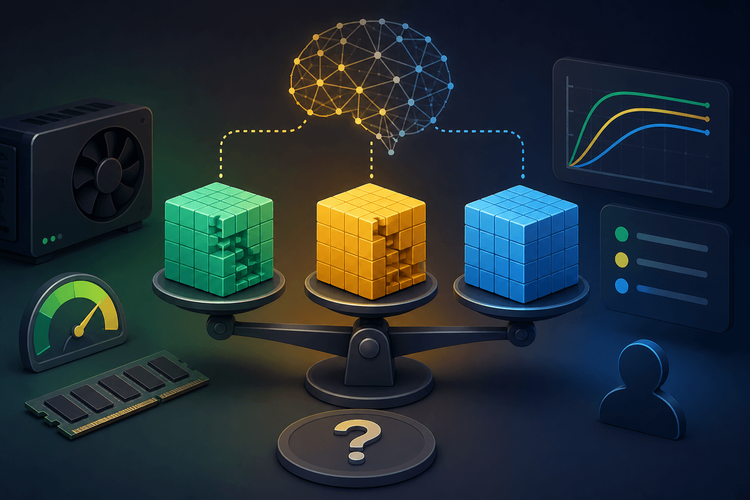
Provides a clear framework for choosing between Q4, Q6, and Q8 quantization levels, with side-by-side quality comparisons and real-world examples of when the differences matter.
Continue reading
Q4 vs Q6 vs Q8: The Quantization Decision Framework for Local LLMs
on SitePoint.
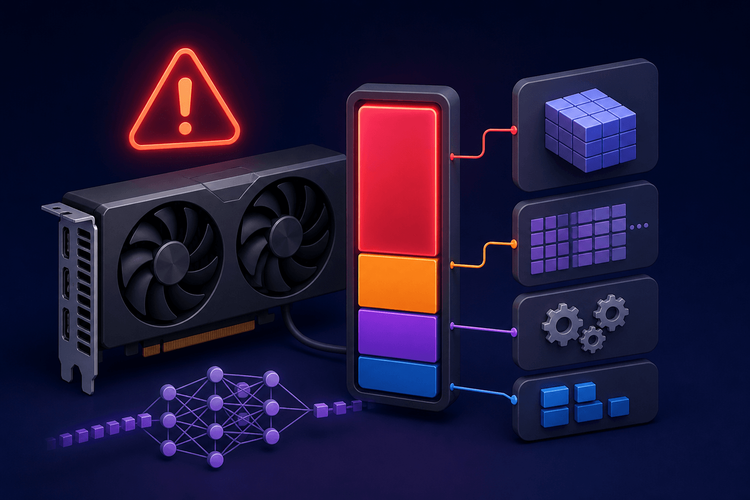
Addresses the #1 pain point for developers using local LLMs: VRAM bottlenecks. Explains why GPUs run out of memory mid-conversation and provides a visual calculator for model weights + KV cache + overhead.
Continue reading
The KV Cache Survival Guide: Why Your GPU Runs Out of Memory with Local LLMs
on SitePoint.
At scale you're always mid-migration but you never do a big-bang rewrite, right? I think that's changing 🤨
You see the secret of our industry is that "you never rewrite your software" but we're all always rewriting our software. When the business changes every 6 months, what else are you gonna do?
https://twitter.com/Swizec/status/1924875257669943383
Continue reading →
Hello every Rustaceans here. I've known Rust the programming language since pre-1.0 era. I like it a lot, and used it to write (embarrassingly small) projects. However, AFAIK virtually all Rust tutorials are written for readers who already know another programming language. I ... hate it, so I tried to write a tutorial for absolute beginners, while at the same time I also learned the more advanced / lesser known features of Rust. (Because I wasn't actually that good at Rust.) This tutorial is es
Open-source skills for controlling AIhttps://github.com/mattpocock/skillsThese Skills turn AI from an “improvising assistant” into a controlled engineering tool. They solve real pain points of working with AI: reduce chaos and hallucinations, save tokens, scale well, and increase predictability. LLMs quickly “get dumber” due to attention degradation in long sessions, so the approach deliberately breaks work into smaller pieces, preserves what is already understood, and passes context thr
I’ve been building Sirraya QuTub Transpiler, a Rust library for compiling OpenQASM circuits across multiple hardware backends. Recent work includes refactoring the backend architecture from a closed enum with scattered match statements into an extensible trait-based design (BackendSpec), making it easier to add new hardware targets while preserving existing behaviour. I’d appreciate feedback on the architecture, API design, and compiler pipeline. Contributions are welcome if the project inte
mirador: terminal dashboard (clocks, calendar, weather, notes, .ics agenda, RSS feeds, market watchlist, CPU/network graphs) Configurable grid layout. Panels dim when unfocused so one thing stands out at full brightness. Rust 1.95+, MIT, macOS/Linux/Windows, cargo install mirador — https://github.com/jchultarsky/mirador submitted by /u/No-Palpitation-5060 [link] [comments]
Clearing houses, the shared memory layer agents read and write, are the high ground of the agent era. They are also the softest thing in the stack. Why memory poisoning is the breach pattern this architecture invites, and the four properties that have to be designed in.
Modern datacenters operate at extraordinary scale. Large cloud platforms deploy fleets comprising millions of processors, each integrating increasingly complex components. As scale and complexity grow, so does the exposure to processor faults. While many faults manifest as crashes or exceptions, others are far more subtle to identify. Silent data corruptions (SDCs), also known as silent data errors26 or silent errors,13 are violations of data integrity that occur without immediate, observable, a
any ideas anyone can provide. i was thinking like a module based out of rust that can be used for preprocessing etc. any ideas if anyone can have on this? submitted by /u/maniteja__k [link] [comments]
Kimi K3 has became so popular that the company has closed registration for new subscription plans. For a long time, it simply showed "Sold Out", and now there is a waiting list.
Opus 5 Frequently Makes Mistakeshttps://www.anthropic.com/news/claude-opus-5https://news.ycombinator.com/item?id=49038433On July 24, Anthropic released Claude Opus 5, which performs close to Fable 5 on benchmarks but is more affordable. In Anthropic's demo, without access to "viewing" the blueprint, the model writes a CV
Postgres ships with a genuinely bountiful catalog of built-in functions. There are literally thousands of them, covering everything from trigonometry to JSON path queries to full-text ranking. It's a kitchen sink of staggering proportions. Somehow despite all of that, there are actually still a few gaps to fill.Need a random date for some test data? That's going to be an entire expression, I'm afraid. How about the exact definition of a role, tablespace, or database? You better have a GUI databa
 Machine Learning and AI