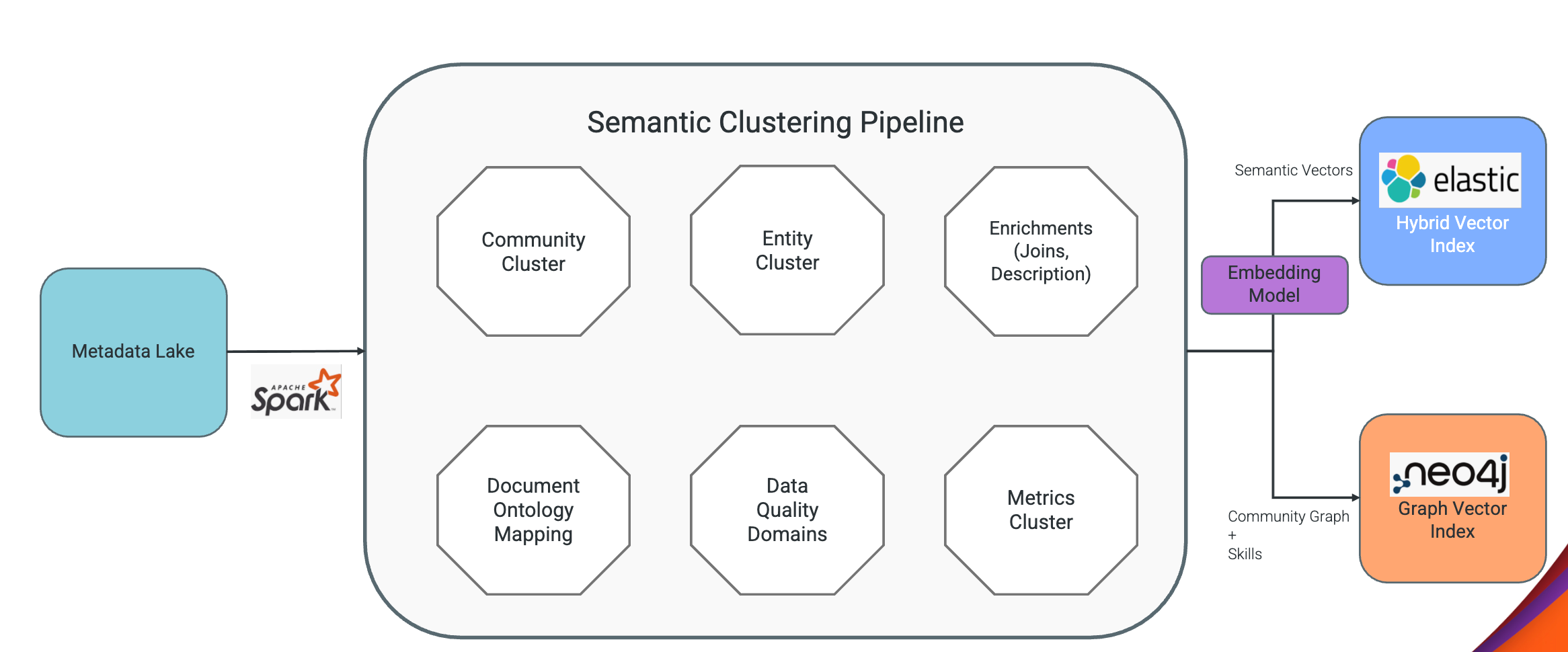
Most Postgres management tools ask you to pick a lane. You can manage databases, or you can manage the services around them. You can run in containers, or you can run on bare metal. You get one deployment model, one operational surface, one set of assumptions about how your infrastructure works.The pgEdge Control Plane just added two features that refuse to pick a lane: Supporting Services and systemd Support. Together, they push the Control Plane into territory that, as far as we can tell, n...
In our Engineering Energizers Q&A series, we highlight the engineering minds driving innovation across Salesforce. Today, we spotlight Neha Awasthi, Senior Manager of Software Engineering at Informatica and the engineering leader behind CLAIRE, a multi-agent AI system embedded across the Intelligent Data Management Cloud (IDMC) that executes enterprise data workflows at a 90% task success […]
The post How Informatica Built a Multi-Agent AI System to Reduce Data Workflows from Months to Days...
404 Media has obtained a copy of ‘Haotian AI’, a popular piece of realtime deepfake software marketed to scammers. It can turn a fraudster's face into anyone else's on WhatsApp, Zoom, and Teams.
A PostgreSQL primary loses power at 2am. Writes resume in under thirty seconds. The on-call engineer reads the alert in the morning, sees that the cluster healed itself, and goes back to coffee. That is the outcome PostgreSQL high availability is supposed to deliver.A working Patroni cluster, on its own, gets you partway there. The leader election runs. A standby gets promoted. The cluster state in etcd stays consistent. Then the application keeps trying to reach an IP address that points at ...
This is today’s edition of The Download, our weekday newsletter that provides a daily dose of what’s going on in the world of technology. What’s next for IVF IVF has brought millions of babies into the world over the last four decades. But the process can still be slow, painful, and expensive—and far from guaranteed…
Forty-eight years ago this July, Louise Joy Brown became the world’s first person born with the help of in vitro fertilization. Millions more IVF babies have entered the world since then. And that’s partly thanks to advances in technology that have made IVF safer and more effective. But it’s still not perfect. The process can…
arXiv:2605.04061v1 Announce Type: new
Abstract: Understanding how large language models encode task identity from few-shot demonstrations is a central open problem in mechanistic interpretability. Prior work uses linear probing to localize task representations, reporting high classification accuracy at specific layers. We reveal a striking dissociation: probing accuracy completely fails to predict causal importance. Single-position activation intervention achieves 0% task transfer across all...
arXiv:2605.04060v1 Announce Type: new
Abstract: Recently, a new paradigm named \emph{drifting model} has been proposed for mapping distributions, which achieves the SOTA image generation performance over ImageNet via one-step neural functional evaluation (NFE). The basic idea is to compute a drifting term at each training iteration and then push the output of the model towards the direction of the drifting term. In this paper, we propose a \emph{lookahead drifting model}. At each training it...
arXiv:2605.04059v1 Announce Type: new
Abstract: Deep learning models continue to scale, with some requiring more storage than many large-scale datasets. Thus, we introduce a new paradigm: Continual Distillation (CD), where a student learns sequentially from a stream of teacher models without retaining access to earlier teachers. CD faces two challenges: teacher training data is unavailable, and teachers have varying expertise. We show that external unlabeled data enables Unseen Knowledge Tra...
arXiv:2605.04058v1 Announce Type: new
Abstract: Parameter-efficient transfer learning (PETL) has emerged as a pivotal paradigm for adapting pre-trained foundation models to downstream tasks, significantly reducing trainable parameters yet suffering from substantial memory overhead caused by gradient backpropagation during fine-tuning. While memory-efficient transfer learning (METL) circumvents this challenge by bypassing backbone gradient computation via lightweight small side networks, its ...
arXiv:2605.04057v1 Announce Type: new
Abstract: This paper focuses on a key challenge in Neural Architecture Search (NAS): integrating established architectural knowledge while exploring new designs under expensive evaluations. Large language models (LLMs) are a promising assistant for NAS because they can translate rich architectural and coding priors into executable code edits. However, in practice, seemingly local revisions often propagate into non-local behavioral and performance shifts ...
arXiv:2605.04056v1 Announce Type: new
Abstract: Representation learning seeks meaningful sensory representations without supervision and can model aspects of human development. Although many neural networks empirically learn useful features, a principled account of what makes a representation "good" remains elusive. We study unsupervised categorization of transformations between pairs of inputs under algebraic constraints. Classical disentanglement favors mutually independent factors and fai...
arXiv:2605.04055v1 Announce Type: new
Abstract: Adaptive optimizers like AdamW apply uniform hyperparameters across all parameter groups, ignoring heterogeneous optimization dynamics across layers and modules. We address this limitation by proposing MetaAdamW - a new optimizer that integrates a self-attention mechanism to dynamically modulate per-group learning rates and weight decay. The modulation factors are produced by a lightweight Transformer encoder that operates on statistical featur...
arXiv:2605.04054v1 Announce Type: new
Abstract: Achieving endogenous regime switching is crucial for the emergence of autonomous intelligence, yet remains a central challenge for existing machine learning frameworks, where such transitions are typically externally imposed. In this work, we introduce a classification that distinguishes scalar-reducible dynamics, which can be expressed as gradient flows driven by a scalar objective, from scalar-irreducible dynamics that cannot be reduced to su...
arXiv:2605.04052v1 Announce Type: new
Abstract: Low Earth orbit (LEO) satellites increasingly carry compute hardware capable of on-board processing, yet each satellite generates roughly two orders of magnitude more data than it can downlink per orbit. This mismatch forces operators to decide, for every workload, which computation runs on-board and which runs on the ground, how intermediate data crosses the space-ground boundary through narrow contact windows, and how to maintain delivery gua...
arXiv:2605.04050v1 Announce Type: new
Abstract: We introduce Lossless Context Management (LCM), a deterministic architecture for LLM memory that outperforms Claude Code on long-context tasks. When benchmarked using Opus 4.6, our LCM-augmented coding agent, Volt, achieves higher scores than Claude Code on the OOLONG long-context eval, including at every context length between 32K and 1M tokens.
LCM may be considered both a vindication and extension of the recursive paradigm pioneered by Rec...
That’s the last post of the series about the talks at the upcoming PG DATA 2026 conference, covering the remaining Friday talks.
Part 1
Part 2
Part 3
First, I wanted to mention two more talks presented by PG DATA organizers: Comparing Apples to Oranges with Postgres’ Type System by Dian Fay and Master Upgrading PostgreSQL, Using Real World stories and examples by Pat Wright. Dian’s talk is about Postgres types, and I can’t say enough how much I love the ability to create n...