It’s harder than ever to be an engineering manager. Fewer resources, higher expectations, and a public conversation actively questioning whether the role should exist at all. Less support than ever, in a job that already often felt hard and lonely. That’s why Jean and I built the Engineering Manager Survival Guide – and I’m so […]
This is today’s edition of The Download, our weekday newsletter that provides a daily dose of what’s going on in the world of technology. Three things in AI to watch, according to a Nobel-winning economist A few months before he won the Nobel Prize in economics in 2024, Daron Acemoglu published a paper that earned…
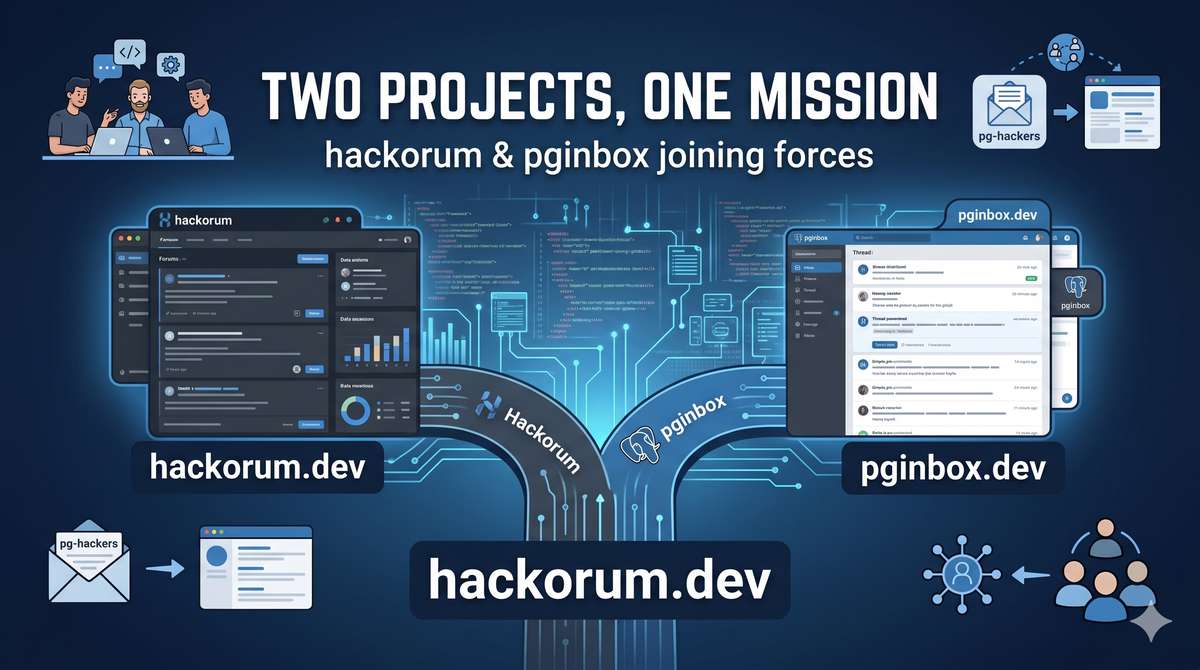
Last week, Zsolt and I jumped on a call with someone who had been building something remarkably similar to what we had been working on, completely independently. That someone is Jack Bonatakis, the creator of pginbox.dev, and that call turned into one of the most energizing conversations we’ve had since launching hackorum.dev.
Two builders, one problem
When we launched Hackorum back in January, the goal was simple but important: make the pg-hackers mailing list actually readable. The list i...
At HumanX, Ryan is joined by Philip Rathle, CTO at Neo4j to discuss what knowledge context means for AI agents, how limitations like stale training data make the model-only approach to agents a bad fit for enterprise environments, and how Graph RAG raises the bar for accuracy and reduces context rot by combining vectors with a knowledge graph so agents are more targeted and connected.
arXiv:2605.06681v1 Announce Type: new
Abstract: A hierarchical ensemble pipeline is introduced to address anomaly detection in multivariate telemetry data provided by European Space Agency (ESA). The method integrates shapelet-based and statistical feature extraction, per-channel modeling, intra-channel stacking, and a final cross-channel aggregation. The pipeline is trained and validated using time-series cross-validation and two-level masking strategies to prevent information leakage. Resu...
arXiv:2605.06680v1 Announce Type: new
Abstract: Flow matching generates data by integrating a learned velocity field, where the number of integration steps (NFE) directly determines inference cost. We analyze which properties of the velocity field govern integration error by decomposing the velocity Jacobian into its symmetric part S (strain rate) and antisymmetric part Omega (vorticity). We prove that strain and vorticity play different roles: strain controls exponential error amplification...
arXiv:2605.06679v1 Announce Type: new
Abstract: Vision-Language Models (VLMs) are frequently undermined by object hallucination, generating content that contradicts visual reality, due to an over-reliance on linguistic priors. We introduce Positive-and-Negative Decoding (PND), a training-free inference framework that intervenes directly in the decoding process to enforce visual fidelity. PND is motivated by our finding of an attention imbalance in VLMs, where visual features are under-weight...
arXiv:2605.06678v1 Announce Type: new
Abstract: According to the United Nations Office for Disaster Risk Reduction (2025), the average annual cost of natural catastrophes increased from 70--80 billion USD between 1970 and 2000 to 180--200 billion USD between 2001 and 2020. Reports from organizations such as the IFOA and the WWF highlight the need for the insurance sector to adapt to this rapidly evolving context by developing medium- to long-term strategies that go beyond the one-year horizo...
arXiv:2605.06676v1 Announce Type: new
Abstract: Long-context inference in Large Language Models (LLMs) is bottlenecked by the linear growth of Key-Value (KV) cache memory. Existing KV cache compression paradigms are fundamentally limited by heuristics: heuristic budgeting relies on statistical priors rather than task objectives, causing resource misallocation, while heuristic selection relies on coupled query-key interactions or static inductive biases (e.g., attention sinks). To address thi...
arXiv:2605.06675v1 Announce Type: new
Abstract: Large language models cache all previously computed key-value (KV) pairs during generation, and this KV cache grows linearly with sequence length, making it a primary memory bottleneck for serving. Quantizing the KV cache to fewer bits reduces this cost, yet all current quantizers assign the same bit-width to every attention head, ignoring the large variation in head importance. A natural idea is to allocate more bits to important heads and few...
arXiv:2605.06673v1 Announce Type: new
Abstract: Aggregate metacognitive quality scores mask within-model variation across MMLU benchmark domains. We administered 1,500 MMLU items (250 per domain, under an a priori six-domain grouping) to 33 frontier LLMs from eight model families and computed Type-2 AUROC per model-domain cell using verbalized confidence (0-100). Total observations: 47,151. Every model with above-chance aggregate monitoring showed non-trivial domain-level variation. Applied/...
arXiv:2605.06672v1 Announce Type: new
Abstract: Chain-of-thought (CoT) reasoning and reasoning-tuned models such as DeepSeek-R1 are commonly assumed to reduce shallow heuristic biases by thinking carefully. We test this on position bias in multiple-choice QA and find a different story: within any reasoning-capable model, per-question position bias scales with the length of the reasoning trajectory.
Across thirteen reasoning-mode configurations (two R1-distilled 7-8B models, two base models...
arXiv:2605.06671v1 Announce Type: new
Abstract: Large Language Models (LLMs) have demonstrated strong potential for many mathematical problems. However, their performance on graph algorithmic tasks is still unsatisfying, since graphs are naturally more complex in topology and often require systematic multi-step reasoning, especially on larger graphs. Motivated by this gap, we propose GraphDC, a Divide-and-Conquer multi-agent framework for scalable graph algorithm reasoning. Specifically, ins...
arXiv:2605.06669v1 Announce Type: new
Abstract: Educational LLM tutors face a core AI alignment challenge: they must follow user intent while preserving pedagogical constraints and safety policies. We present an evaluation methodology for prompt-injection defenses in this setting, showing that guardrail design entails explicit trade-offs among adversarial robustness, benign-task usability, and response latency. We evaluate a domain-specific multi-layer safeguard pipeline combining determinis...
Introduction
Over the past year, I’ve worked in a handful of contexts managing large volumes of data stored as JSONB in PostgreSQL. The scenario is common: users appreciate the flexibility of a document-oriented storage model, avoiding the need to predefine schemas or constantly migrate table structures as their data requirements evolve. JSONB documents can be deeply nested with numerous optional fields, and they scale to hundreds of kilobytes per record without issue. However, when the ti...
Bit of a news catchup on the pg_clickhouse project.
What’s New
First up, a couple weeks ago the ClickHouse Blog published What’s New in
pg_clickhouse, in which I covered various improvements to the extension:
We’ve been gratified by the community reception of pg_clickhouse, the
extension to query ClickHouse databases from Postgres. Recent uptake
generated a ton of feedback, which we’ve been diligently addressing in the
last few releases. These changes follow our constant...
Chin made foundational contributions to database systems, distributed systems, blockchain systems, machine-learning systems, and large-scale data analytics.
 Software Engineering