 Defense Tech
Defense Tech
Defense Tech
Defense Tech
Defense Tech
 Privacy
 Fintech
 Anthropic
Much of the architecture for investigation-grade tooling already exists, but in pieces.
 Meta
Meta
 Open Source
 Meta
Meta
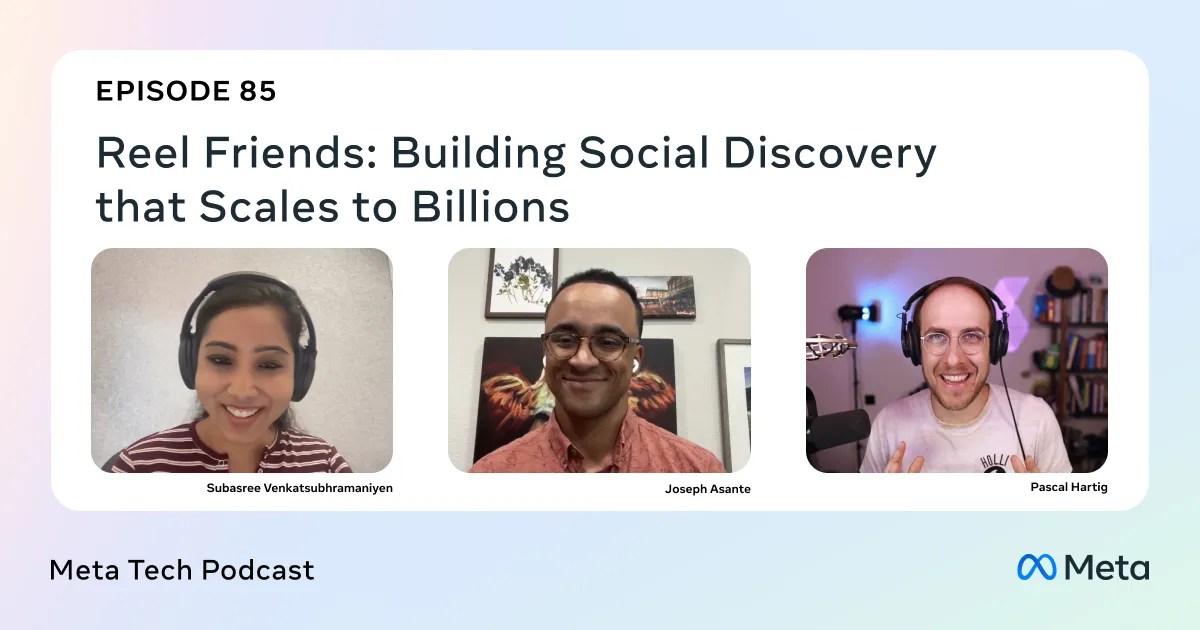
On its face the new Friend Bubbles feature looks simple enough. It highlights Reels your friends have watched and reacted to. But sometimes the features that seem the most straightforward require the deepest engineering work. On this episode of the Meta Tech Podcast, Pascal Hartig chats with Subasree and Joseph, two software engineers from the Facebook [...] Read More... The post Reel Friends: Building Social Discovery that Scales to Billions appeared first on Engineering at Meta.
 Developer Tools
“It's making me dumber for sure.”
 Space Tech
This is today’s edition of The Download, our weekday newsletter that provides a daily dose of what’s going on in the world of technology. A plan to make drugs in orbit is going commercial A startup called Varda Space Industries is betting that the future of pharmaceuticals lies in orbit. The company has signed a…
 Privacy
 Homelab & Self-Hosting
 Artificial Intelligence
 C++
C++
 Anthropic
 Exploit Development
 Testing
This article presents two approaches of how TDD can be applied. The first is the classic one where the objects are treated as black-boxes and verification is based on the objects state. The second one is focused on interactions.
 Embedded Systems
 PostgreSQL
A step-by-step guide to migrating a PostgreSQL 17 cluster managed by Crunchy PGO v6 to PostgreSQL 18 under CloudNativePG. Two paths are covered: a fully declarative offline migration using CloudNativePG’s built-in pg_dump import, and an online migration using native PostgreSQL logical replication for a near-zero-downtime cutover.
Space Tech
Varda Space Industries, a startup that’s been pitching its ability to perform drug experiments in space, says it has signed up the pharmaceutical company United Therapeutics in what may be remembered as a notable step toward in-orbit manufacturing. The idea of building things in outer space for use on Earth has so far been explored…
 SRE
SRE
 AI Psychosis
submitted by /u/TheCrush0r [link] [comments]
 Privacy
 Startups and Venture
 PostgreSQL
PGConf Belgium took place on 5 May 2026, organized by Wim Bertels, An Vercammen, and Grégory Gioffredi , who served also at the talk selection team. Speaker: Jan Karremans Boriss Mejias Dwarka Rao Emrah Becer Robert Treat Franck Pachot Mohsin Ejaz Afroditi Loukidou Gianni Ciolli Bruce Momijan Matt Cornillon Xavier Fisher Thijs Lemmens Josef Machytka Claire Giordano and Aaron Wislang hosted and published a new podcast episode on May 6, 2026 From MemSQL to HorizonDB, an engineer's journey ...
 Computer Vision
 DNS
DNS
 Compilers
 AI Psychosis
Why AI-accelerated teams keep breaking production — and what the ones that don't are doing differently
 Software Engineering
Jon Hyman, co-founder and CTO of Braze, shares how he's led the company's engineering organization over nearly 15 years of growth — and how they transformed into an AI-first team in just a few months.
Large Language Models
arXiv:2605.10980v1 Announce Type: new Abstract: Diffusion Language Models (dLLMs) have garnered significant attention for their potential in highly parallel processing. The parallel capabilities of existing dLLMs stem from the assumption of conditional independence at high confidence levels, which ensures negligible discrepancy between the marginal and joint distributions. However, the stringent confidence thresholds required to preserve accuracy severely constrain the scalability of paralle...
RAG
arXiv:2605.10977v1 Announce Type: new Abstract: Watermarking for large language models (LLMs) is a promising approach for detecting LLM-generated text and enabling responsible deployment. However, existing watermarking methods are often vulnerable to semantic-invariant attacks, such as paraphrasing. We propose PASA, a principled, robust, and distortion-free watermarking algorithm that embeds and detects a watermark at the semantic level. PASA operates on semantic clusters in a latent embeddi...
Graph Databases
arXiv:2605.10975v1 Announce Type: new Abstract: Graphs with heterophily, where adjacent nodes carry different labels, are prevalent in real-world applications, from social networks to molecular interactions. However, existing spectral Graph Neural Network (GNN) approaches tailored for heterophilous graph classification suffer from hub-dominated (node with large degree) aggregation and oversmoothing, as their suboptimal polynomial filters introduce approximation errors and blend distant signa...
Large Language Models
arXiv:2605.10974v1 Announce Type: new Abstract: Certified verification of transformer attention requires bounding the softmax function over interval constraints on the pre-softmax scores. Existing verifiers relax softmax ndependently of the downstream objective, leaving avoidable slack. We prove that the exact optimum of this score-box problem is attained at a vertex of the constraint box, and establish a threshold structure theorem showing that, after sorting the objective coefficients, the...
Fine-tuning and PEFT
arXiv:2605.10973v1 Announce Type: new Abstract: Supervised fine-tuning (SFT) improves in-domain performance but can degrade out-of-domain (OOD) generalization. Prior work suggests that this degradation is related to changes in dominant singular subspaces of pretrained weight matrices. However, directly identifying loss-sensitive directions with Hessian or Fisher information is computationally expensive at LLM scale. In this work, we propose preserving projected rotations in pretrained singul...
Diffusion Models
arXiv:2605.10971v1 Announce Type: new Abstract: Discrete diffusion language models (DLMs) generate text by iteratively denoising all positions in parallel, offering an alternative to autoregressive models. Controlled generation methods for DLMs, imported from autoregressive models, apply uniform intervention at every denoising steps. We show this uniform schedule degrades quality, and the damage compounds when multiple attributes are steered jointly. To diagnose the failure, we train sparse ...
Artificial Intelligence
arXiv:2605.10966v1 Announce Type: new Abstract: Terminals provide a powerful interface for AI agents by exposing diverse tools for automating complex workflows, yet existing terminal-agent benchmarks largely focus on tasks grounded in text, code, and structured files. However, many real-world workflows require practitioners to work directly with audio and video files. Working with such multimedia files calls for terminal agents not only to understand multimedia content, but also to convert a...
RAG
arXiv:2605.10964v1 Announce Type: new Abstract: Embedding advertisements into large language model (LLM) outputs introduces a fundamental tension: revenue optimization can distort content and degrade user experience. Existing approaches largely ignore this trade-off, often forcing irrelevant ads into responses. We propose a quality-preserving auction framework that explicitly integrates content fidelity into the mechanism design. Built on retrieval-augmented generation (RAG), our approach tr...
Fine-tuning and PEFT
arXiv:2605.10959v1 Announce Type: new Abstract: There is currently no unified metric for evaluating the efficiency of quantized neural networks. We propose QuIDE, built around the Intelligence Index I = (C x P)/log_2(T+1), which collapses the compression-accuracy-latency trade-off into a single score. Experiments across six settings -- SimpleCNN (MNIST, CIFAR), ResNet-18 (ImageNet-1K), and Llama-3-8B -- show a task-dependent Pareto Knee. 4-bit quantization is optimal for MNIST and large LLMs...
AI Psychosis
arXiv:2605.10947v1 Announce Type: new Abstract: EEG microstate analysis segments continuous brain electrical activity into brief, quasi-stable topographic configurations that reflect discrete functional brain states. Conventional approaches such as Modified K-Means operate directly in electrode space with hard assignment, offering no learned latent representation, no generative decoder, and no mechanism to decode latent configurations into verifiable scalp topographies, limiting both model t...
 X / Twitter
 AI Psychosis
Large Language Models
AI Psychosis
Large Language Models
arXiv:2605.09472v1 Announce Type: new Abstract: Positional encoding in transformers is commonly implemented through positional embeddings, attention masks, or bias terms, but formal connections between these mechanisms remain limited. We study attention with positional bias through the lens of locality-sensitive hashing (LSH), focusing on Attention with Linear Biases (ALiBi). We show that the ALiBi bias matrix is the expectation of contiguous block-diagonal binary masks induced by a ``positi...
X / Twitter
arXiv:2605.09469v1 Announce Type: new Abstract: This paper explores the use of emojis in financial sentiment analysis, focusing on the social media platform StockTwits. Emojis, increasingly prevalent in digital communication, have potential as compact indicators of investor sentiment, which can be critical for predicting market trends. Our study examines whether emojis alone can serve as reliable proxies for financial sentiment and how they compare with traditional text-based analysis. We co...
Multimodal AI
arXiv:2605.09468v1 Announce Type: new Abstract: Multimodal Intent Recognition (MIR) aims to understand complex user intentions by leveraging text, video, and audio signals. However, existing approaches face two key challenges: (1) overlooking intricate cross-modal interactions for distinguishing consistent and inconsistent cues, and (2) ineffectively modeling multimodal conflicts, leading to semantic cancellation. To address these, we propose a novel Cognitive Dual-Pathway Reasoning (CDPR) f...
Algorithms and Data Structures
arXiv:2605.09464v1 Announce Type: new Abstract: We prove that no deterministic output-sensitive algorithm for the planar convex hull and maxima problems can obtain both optimal time and I/O complexity, where the optimality is defined with respect to both the input and output sizes. This explains why the best previous algorithms achieved an optimal I/O bound at the cost of sub-optimal running time (Goodrich et al. [FOCS, 1993]). To the best of our knowledge, the impossibility of simultaneous ...
Large Language Models
arXiv:2605.09463v1 Announce Type: new Abstract: Large Language Models (LLMs) have demonstrated exceptional performance across diverse tasks. However, their deployment in long-context scenarios faces high computational overhead and information redundancy. While soft prompt compression has emerged as a promising way to mitigate these costs by compressing sequences into compact embeddings, existing paradigms remain fundamentally constrained by position bias: they primarily rely on learnable tok...
Security Engineering
arXiv:2605.09461v2 Announce Type: new Abstract: Automated vulnerability detection is a fundamental task in software security, yet existing learning-based methods still struggle to capture the structural dependencies, domain-specific vulnerability knowledge, and complex program semantics required for accurate detection. Recent Large Language Models (LLMs) have shown strong code understanding ability, but directly prompting them with raw source code often leads to missed vulnerabilities or fal...
Diffusion Models
arXiv:2605.09460v1 Announce Type: new Abstract: Identity-preserved image generation is typically built on many-step diffusion backbones, making personalized generation expensive at deployment time. We show that this cost is often unnecessary for identity-conditioned FLUX generation. A frozen InfuseNet identity adapter trained with dev transfers directly to the distilled schnell backbone without retraining. This two-line replacement -- changing the backbone path and disabling classifier-free ...
Fine-tuning and PEFT
arXiv:2605.09457v1 Announce Type: new Abstract: While Graph Neural Networks (GNNs) have demonstrated significant efficacy in node classification tasks, where predictions rely on local neighborhood information, the performance of GNNs often drops when prediction tasks depend on long-range interactions. These limitations are attributed to phenomena such as oversquashing, where structural bottlenecks restrict signal propagation across the network topology. To address this challenge, we introduc...
 PostgreSQL
PostgreSQL's complicated relationship with the Linux page cache spawns four GUCs to manage writeback—and backend_flush_after is the conservative one.
 AI Psychosis
 MongoDB
Deploy ParadeDB on Render with one click. Full-text search, vector search, and hybrid search over Postgres — now available on your favorite cloud platform.
 Apple
MongoDB
Apple
MongoDB
Deploy ParadeDB on Render with one click. Full-text search, vector search, and hybrid search over Postgres — now available on your favorite cloud platform.
 X / Twitter
 Web Application Security
 Privacy
 Artificial Intelligence
 Open Source
 Meta
Meta